• Same-day results, we explain your hearing test before you leave
  • No referral needed, book directly with us
  • Newborn hearing screening and ABR testing available
  • Hearing aid batteries and accessories, walk in, no appointment
  • Speech therapy for children and adults, in clinic or online
  • Custom ear plugs moulded to your own ears
  • Workplace hearing programmes for employers across Uganda
  • Open Mon to Fri 9am to 5pm, Saturday 9am to 2pm, Kabalagala, Kampala
  • Call +256 748 626218

For employers

Occupational Hearing Conservation Uganda

Noise-induced hearing loss is one of the most common occupational health risks worldwide and one of the least reported in this region. It develops quietly over years, there is no pain to warn anyone, and by the time a worker notices, the damage is permanent.

For an employer that is a health issue, a productivity issue and a liability issue at the same time. Workers who cannot hear instructions clearly make more mistakes, and workers who cannot hear a reversing alarm are a safety risk to everyone on site. We design and implement hearing protection strategies that safeguard employees and support compliance with health and safety standards. The World Health Organization lists occupational noise as a leading preventable cause of hearing loss in adults.

Programmes are built around how your site actually runs. We arrange testing around shift patterns so production is not disrupted, and we keep the records in a format you can hand to an auditor without having to reassemble anything.
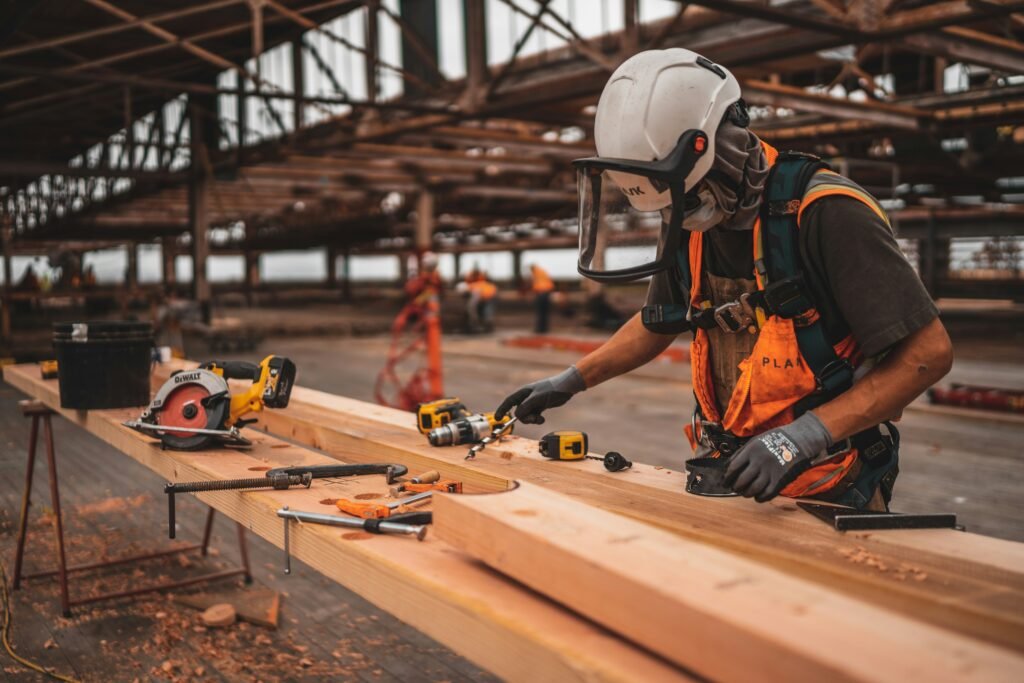
Carpenter using power tools at a workbench, a typical high noise workplace

How loud is too loud?

Approximate sound levels, decibels
85 dB — action level

60

85

95

105

Normal conversation

Busy workshop

Angle grinder

Generator room

A working test with no meter: if two people an arm’s length apart have to raise their voices to be understood, the environment is loud enough to cause damage over a sustained period.

Occupational Hearing Conservation Uganda: What We Offer

Our experts conduct thorough noise surveys to identify problem areas, measure exposure levels, and provide actionable recommendations in line with occupational health regulations.

From specialized earplugs to high-performance earmuffs and advanced noise-cancelling devices, we offer tailored protection solutions that meet the unique needs of each industry.

  • Educating staff on the importance of hearing protection is key. We deliver workshops and training programs to build awareness, encourage adoption, and reduce long-term hearing risks.

Every worker in an at-risk role is tested when they join, or when the programme starts. That baseline is what all later tests are compared against, and it protects the employer as much as the employee because it establishes what hearing was like before employment. Annual or biannual retesting then shows whether hearing is shifting, so a small change can be acted on before it becomes permanent.
Different noise levels and different jobs need different protection. We recommend what suits each role and supply custom-moulded plugs where they make sense. Protection that is uncomfortable does not get worn, so fit is not a cosmetic detail.
Short, practical sessions on why noise damages hearing, how to use protection properly, and what warning signs to report. Compliance improves sharply when people understand the reason rather than just the rule.
Documented results for each worker, tracked over time, in a format you can produce for an audit or an occupational health review.
Manufacturing and processing plants, construction sites, quarries and mining, steel and metal fabrication, timber and carpentry workshops, bottling and packaging lines, standby generator environments, transport depots, agro-processing, and hospitality venues with sustained loud music.
As a working guide, if two people standing an arm’s length apart have to raise their voices to be understood, the environment is loud enough to cause damage over a sustained period. Most people are surprised how many areas of a working site meet that test.
It begins with a conversation about your site, roughly how many workers are in noisy roles, and what you already have in place. We then visit and measure, and you get a written report with findings and recommendations. From there we agree who is included, how often testing happens and what protection is issued, and we arrange rollout around shift patterns so production is not disrupted.
Scroll to Top