
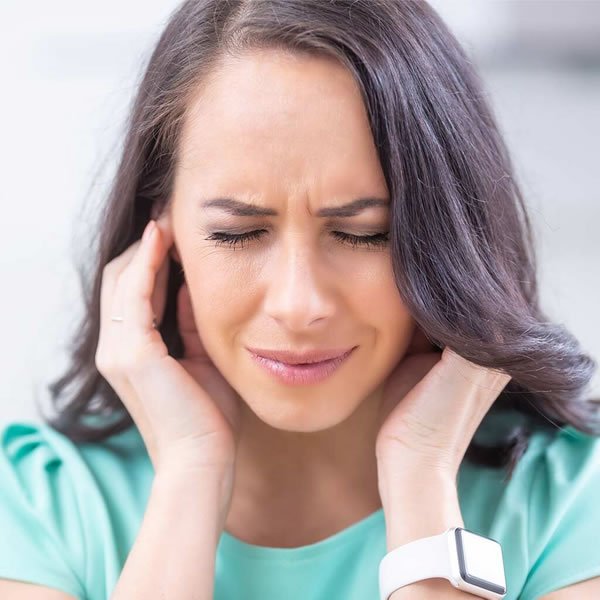
Ringing in the ears usually starts in the evening, when the house goes quiet. A ringing, a hiss, a high whine or a rushing sound that nobody else can hear. For some people it comes and goes. For others it never stops, and the quiet moments that should be restful become the worst part of the day.
Tinnitus is not a disease. It is a symptom, and it is extremely common. It is also widely misunderstood, and people are often told there is nothing to be done. That is not true. There may be no switch that turns it off, but there is a great deal that can be done about how much it intrudes.
The short version
- Tinnitus is a symptom, not a diagnosis. The first job is to find out what is driving it.
- It is very often linked to hearing loss, and treating the hearing loss frequently reduces the tinnitus.
- Wax, ear infection and middle ear problems are common causes and are straightforward to treat.
- Tinnitus in one ear only, or pulsing in time with your heartbeat, should be assessed promptly.
- Silence makes tinnitus louder. Managing your sound environment is one of the most effective things you can do.
What tinnitus actually is
The simplest way to understand it is this. Your ear sends signals to your brain constantly. When part of the hearing system stops delivering certain frequencies, the brain does not simply go quiet on those channels. It turns up its own internal gain, listening harder for signal that is no longer arriving, and you become aware of activity that was always there in the background.
That is why tinnitus so often accompanies hearing loss, and why it commonly sits at the pitch where hearing is worst. It is not imaginary and it is not a sign that you are losing your mind. It is the hearing system responding to a change in what it is receiving.
Common causes of tinnitus
Noise exposure
The most common cause worldwide. Generators, workshops, power tools, loud music, bars and clubs, firearms. Damage builds quietly over years, and the ringing after a loud night that used to disappear by morning eventually stops disappearing.
Age-related hearing loss
Hearing changes gradually from middle age onward, and tinnitus frequently arrives alongside it.
Wax and ear infections
Very common, very treatable, and worth ruling out before anything else. Compacted wax against the eardrum, or fluid behind it, can produce ringing that resolves completely once the cause is dealt with.
Middle ear problems
A perforated eardrum, or problems with the small bones behind it, can produce tinnitus along with hearing difficulty.
Medication
Some medicines affect the inner ear. Certain antibiotics, some chemotherapy drugs, and high doses of aspirin are the usual examples. Never stop a prescribed medicine on your own; raise it with the doctor who prescribed it.
Stress, sleep and blood pressure
These rarely cause tinnitus outright, but they reliably make it feel louder. Most people notice their tinnitus is worse in a bad week, and that is real rather than imagined.
When to get it checked promptly
Most tinnitus is not dangerous. A few patterns should be assessed without delay:
- Tinnitus in one ear only, particularly if it came on suddenly
- A sound that pulses in time with your heartbeat
- Tinnitus alongside sudden hearing loss
- Tinnitus with dizziness, vertigo or a feeling of fullness in the ear
- Tinnitus following a head injury
- Tinnitus with discharge or pain from the ear
None of these means something serious is certain. They mean the cause needs identifying rather than waiting.
What an assessment involves
We start by examining the ear canal and eardrum, because wax and infection are common and quickly dealt with. Then a full diagnostic hearing test, since tinnitus and hearing loss travel together so often that assessing one without the other tells you very little.
We will ask what the sound is like, when it started, whether it is one ear or both, what makes it worse, and how much it is affecting your sleep and concentration. That last part matters more than people expect. Two people with identical test results can have completely different experiences of the same tinnitus, and the distress is what treatment targets.
The goal is not always to remove the sound. It is to get it to the point where it no longer demands your attention.
Tinnitus treatment that actually helps
Treating the underlying cause
Where there is wax, an infection or a middle ear problem, treating it may resolve the tinnitus completely. This is why assessment comes first.
Hearing aids
Where tinnitus sits alongside hearing loss, correctly fitted hearing aids often reduce it substantially. Restoring the missing frequencies gives the brain real signal again, so it stops straining, and the surrounding sound of ordinary life partially covers the tinnitus. Many people find this alone makes the difference.
Sound therapy and maskers
Silence is the enemy. In a quiet room there is nothing for the tinnitus to compete with, which is why it dominates at night. Low-level background sound gives the brain something else to attend to: a fan, soft music, or a dedicated tinnitus masker set just below the level of the tinnitus itself. The aim is not to drown it out but to stop it being the only thing there.
Retraining how the brain responds
Over time the brain can learn to file tinnitus as unimportant, the way it already ignores the sound of your own breathing. Structured sound therapy combined with counselling works towards exactly that. It takes months rather than days, and it is the approach with the best long-term record.
Protecting the hearing you still have
If noise is part of the picture, protection matters. Custom ear plugs moulded to your own ear seal properly and stay comfortable through a full shift, which foam rarely does. Avoiding total silence is also part of it; over-protecting in quiet environments can make tinnitus more noticeable, not less.
Sleep and stress
Tinnitus and poor sleep feed each other. Sound at night, a consistent routine, and dealing with the stress side genuinely reduce how loud it feels. This is not a brush-off; it is a documented part of managing the condition.
What does not help
There is no pill that cures tinnitus, and any product sold on that promise is worth avoiding. Herbal supplements marketed for tinnitus have not been shown to work. Straining to listen to it, testing whether it is still there, and searching for it in quiet moments all reinforce the pattern you are trying to break. So does total silence.
The World Health Organization notes that over a billion young people are at risk of permanent hearing damage from unsafe listening, and tinnitus is very often the first warning sign that damage is happening.
Common questions
Will my tinnitus ever go away?
Where there is a treatable cause such as wax or infection, often yes. Where it relates to permanent hearing loss it may not disappear, but it very frequently stops being intrusive, which for most people is what matters.
Does tinnitus mean I am going deaf?
Not necessarily, but it is a strong reason to have your hearing tested. Many people discover a hearing loss they had not noticed.
Is it caused by stress?
Stress rarely causes tinnitus on its own, but it reliably makes it louder and harder to ignore.
Should I use earplugs all the time?
No. Use them around genuinely loud noise. Wearing them constantly in quiet environments tends to make tinnitus more noticeable.
Can children get tinnitus?
Yes, and they often do not report it because they assume everyone hears it. If a child mentions noises in their ears, have their hearing checked.
Do I need a referral?
No. You can book a hearing assessment with us directly.
Get the cause identified
Tinnitus is worth assessing rather than living with. We examine the ear, test your hearing properly, and explain what we found the same day. Kings Tower, Nsubuga Road, Kabalagala.
Call +256 748 626218 | Book an appointment